
Aarav had done everything right.
A computer-science degree from a respected university in Bengaluru. Two internships. A side project with real users. By his own count, he had applied to 112 jobs in four months. Tailored cover letters. A clean, modern resume he'd spent an entire weekend designing in a two-column template with a subtle colour accent he was quietly proud of.
The result? Four automated rejections. And silence from the other 108.
He started to believe the problem was him — that he wasn't good enough, that the market had turned, that maybe he'd chosen the wrong field. What Aarav didn't know is that, for most of those 112 applications, no human ever read his resume at all.
If that scenario makes your stomach drop a little, keep reading. Because what's happening to Aarav is happening to millions of qualified candidates right now — and the fix is far more learnable than most people realise.
The Machine Reading Your Resume First
Here's the part the career-advice industry doesn't say loudly enough: before a recruiter ever sees your application, software does.
That system is called an Applicant Tracking System (ATS) — and in 2026 it is no longer a niche corporate tool. Around 93% of recruiters now use an ATS, and roughly 99% of Fortune 500 companies screen applications through one. In high-volume markets like India, where a single popular role can attract hundreds or thousands of applicants, automation isn't a convenience for employers — it's a survival mechanism.
The widely quoted figure is that about 75% of resumes are filtered out before a human sees them. That number is debated — modern systems are smarter than the blunt keyword-matchers of a decade ago — but the underlying truth is not. A 2025 Harvard Business School study found that ATS-style screening can reject as many as 88% of qualified candidates simply because their resumes don't contain the right keywords. And a striking 73% of automated rejection decisions happen in the first 10 seconds, long before any recruiter's coffee has gone cold.
So when Aarav heard nothing back, it usually wasn't a hiring manager deciding he wasn't good enough. It was a parser deciding it couldn't understand him.
Why Good Candidates Get Filtered Out
Once you see how the machine reads, the rejections stop feeling personal and start feeling fixable. The most common reasons qualified people get screened out are almost embarrassingly mechanical:
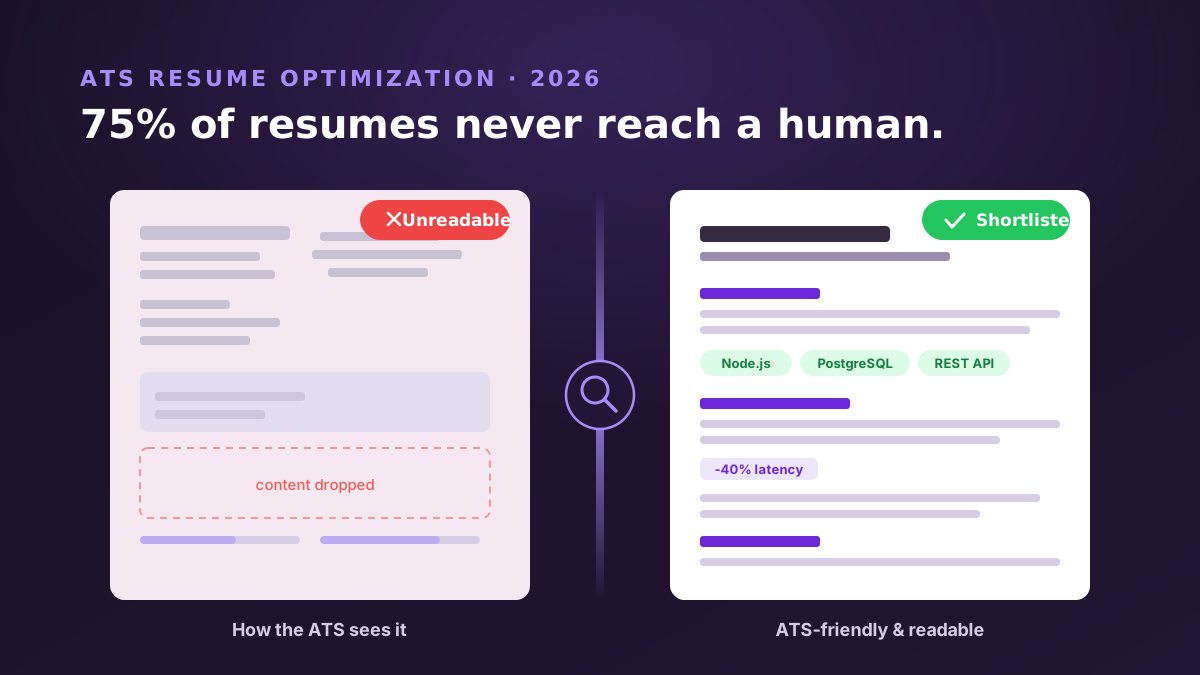
The resume can't be parsed. This was Aarav's mistake. Studies show resumes with tables, graphics, images, or complex multi-column layouts can lose 50% or more of their content when an ATS tries to read them. A clean single-column layout parses correctly around 94% of the time; a two-column design drops noticeably lower. That elegant template was quietly deleting half of Aarav's experience before anyone saw it.
The keywords don't match. An ATS looks for the language of the job description — the specific tools, titles, and skills. If the posting says "data analysis" and your resume says "data crunching," a literal parser may not connect them. Missing even one required credential (a CPA, an RN licence, a PMP, a specific framework) can trigger an automatic filter.
The contact details are hidden. Roughly a quarter of ATS platforms fail to parse names, emails, or phone numbers placed in the header or footer of a document. Imagine clearing every other hurdle and being unreachable.
The file format fights the system. A plain .docx is the safest, most universally readable format. Heavily designed PDFs and exotic file types parse less reliably.
And here's the trend that changes the game for everyone: most candidates are now competing against each other's worst habits. Around 48% of job seekers admit to "spray and pray" applying — blasting the same generic resume at dozens of roles. Recruiters have noticed. 83% now prefer tailored applications, and 78% of hiring managers say personalised details are the strongest signal of genuine interest. Generic is no longer neutral. Generic is a disadvantage.
Aarav's Resume, Rebuilt
Aarav didn't need a new degree. He needed a translation layer between his real experience and the machine reading it. Here's the transformation, step by step — the same roadmap you can follow tonight.
Before: A two-column design, a "Profile" headline in a graphic banner, skills shown as little progress bars, job titles styled creatively ("Code Wrangler" instead of "Software Engineering Intern"), and bullet points like "Worked on backend stuff for the team."
After: A single-column layout. Standard, searchable section headings — Summary, Skills, Experience, Education. Real job titles that match what employers actually search for. Skills written as plain text, not visuals. And bullets rewritten to carry both keywords and proof:
Before: "Worked on backend stuff for the team."
After: "Built and optimised REST APIs in Node.js and PostgreSQL, cutting average response time by 40% across 3 production services."
Same work. Completely different signal. The machine now finds "Node.js," "PostgreSQL," and "REST APIs"; the human now sees a measurable result. Aarav tailored that After-version to each role — adjusting the summary and skills to echo the specific job description — and within three weeks he had two interviews and one final-round.
The lesson isn't to game the system. It's to stop being invisible to it.
The ATS Optimization Framework
Here's the practical structure that works across industries and experience levels.
- Structure it simply. Single column. Standard headings (Summary, Skills, Experience, Education, Certifications). No tables, text boxes, or images. Save and submit as
.docxunless the employer specifies otherwise. - Mine the job description for keywords. Treat each posting as your answer key. Pull out the repeated hard skills, tools, certifications, and the exact job title. These are your target keywords.
- Place keywords where they count. The high-priority zones an ATS weights most: your professional summary, your skills section, your job titles, and the first bullet of each role. Distribute keywords naturally — don't dump them in one block.
- Tailor — don't fabricate. Adding a keyword to describe experience you actually have is professional tailoring. Claiming experience you don't have is fabrication that collapses in the interview. Stay on the right side of it.
- Lead with achievements, not duties. Use the formula action verb + what you did + measurable result. "Increased," "reduced," "led," "automated" — followed by a number. Numbers survive both the algorithm and the hiring manager's 10-second skim.
- Mirror the real job title. If the role is "Business Analyst," make sure your resume says "Business Analyst" somewhere relevant. Clever titles confuse parsers and search filters alike.
- Customise per application. A 70%+ keyword match is a reasonable floor; 80%+ is strong. Resumes scoring above 80% are roughly 3x more likely to reach a recruiter. Yes, tailoring takes time. It's also the highest-return 20 minutes in your job search.
What's Changing: AI, Resumes, and the Near Future
If you think the ATS is the final boss, here's what's coming next — and why it's actually good news for genuinely strong candidates.
In 2026, roughly 82% of companies rely on AI to help sift resumes, and AI has compressed average time-to-hire from around 44 days to as few as 11. But the newest systems have evolved past literal keyword-matching. They use natural-language processing and semantic analysis to understand meaning — recognising that "managed a team" and "led 6 direct reports" describe the same thing, and increasingly evaluating skills and career trajectory regardless of formatting.
That shift rewards substance. As parsing gets smarter, raw keyword tricks fade and demonstrated, well-described, honestly-tailored experience wins. At the same time, screening is moving beyond the resume entirely — AI-driven assessments and AI interviews now sit alongside the ATS, evaluating how you actually think and communicate, not just what your document says.
This is the philosophy platforms like Xakal are built around: using AI to surface real capability — through smarter matching and AI-powered interviews — so that strong candidates aren't lost to a formatting quirk. The takeaway for you as a candidate is freeing: the future of hiring rewards clarity and substance over decoration. Build for that future now.
See how an AI interview actually reads you
Xakal uses AI interviews and smart matching to surface real capability — beyond the resume. Try it free.
Try Xakal free →The Mistakes That Still Sink Good Resumes
Even savvy candidates trip on these. Avoid all seven:
- Keyword stuffing — cramming terms unnaturally or in white text. Modern AI flags it, and humans find it instantly off-putting.
- Complex designs — columns, sidebars, infographics, and "creative" templates that look great to you and unreadable to a parser.
- Tables and graphics — skill bars, charts, logos, and icons that carry information the ATS simply drops.
- Generic, untailored resumes — the same file sent everywhere, in a market that now openly rewards tailoring.
- No measurable achievements — duties without numbers. "Responsible for sales" says far less than "Grew regional sales 24% in 2 quarters."
- Job-title mismatch — clever or internal titles that don't match what recruiters search for.
- Contact info in the header/footer — where a quarter of systems can't read it. Put it in the body.
Your ATS Resume Optimization Checklist
Run every resume through this before you hit apply:
- Single-column layout, no tables, text boxes, images, or graphics
- Saved as
.docx(unless the employer asks otherwise) - Standard section headings (Summary, Skills, Experience, Education)
- Name and contact details in the body, not the header/footer
- Real, searchable job titles (yours and the one you're targeting)
- Keywords pulled from the specific job description
- Keywords placed in summary, skills, titles, and first bullets
- Every role led with achievements + numbers
- All required credentials/certifications stated explicitly
- Tailored to this role — not a generic copy
- Proofread; consistent dates and formatting
- Keyword match feels natural and honest (target 80%+)
The Real Takeaway
Aarav's story didn't change because he became a better engineer in three weeks. It changed because he finally spoke the language of the system standing between him and the people who wanted to hire him.
That's the quiet truth of modern job searching: you are not being rejected as often as you are being misread. And being misread is fixable — tonight, with the checklist above, without changing a single fact about who you are.
The job market in 2026 is faster, more automated, and more AI-driven than ever. But the candidates who understand the machine — and then give it something real to find — don't just get past the bots. They get shortlisted, interviewed, and hired. The tools are catching up to reward substance over decoration. Make sure yours is impossible to overlook.
You've done the hard part already: the experience, the skills, the effort. Don't let formatting be the reason it stays invisible.
Want to know how your resume actually scores before a recruiter sees it? Try an AI interview practice round at thexakal.com — and walk into your next application knowing the machine can read you loud and clear.